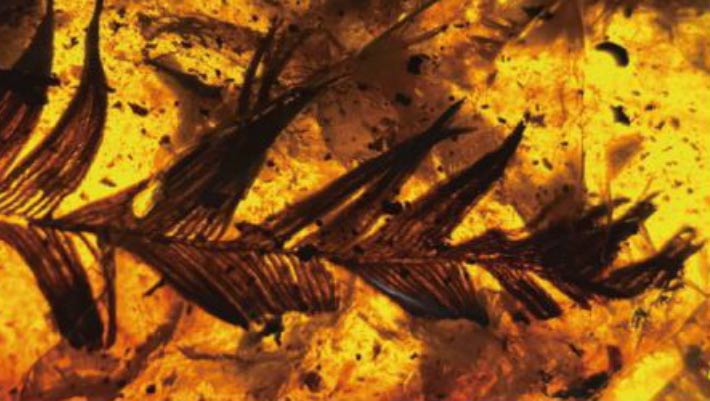
A feather roughly 99 million years old, encased in amber from Myanmar, is the longest three-dimensionally preserved feather of its type yet described, according to a study reported by Sci.News. The specimen, catalogued as ECNU A0033, dates to the Cenomanian age of the Cretaceous period and was donated to the Biology Museum of East China Normal University in 2016 by an anonymous amateur collector. Researchers led by Professor Shuo Wang of East China Normal University published their findings in the journal Gondwana Research on October 31, 2026.
The visible portion of the feather measures about 105 millimeters, with its symmetrical vanes reaching a maximum width of roughly 40 millimeters. Based on the proportions of what survived, the team estimates that the missing base of the feather accounted for about a quarter of its original length, meaning the complete structure likely stretched beyond 140 millimeters.
Why it matters
Pennaceous feathers — the stiff, vaned kind found on modern birds — are treated by scientists as a marker of the theropod-to-bird transition and, often, as a stand-in for flight capability. Most large fossil feathers, however, survive only as flattened carbonized impressions, which rarely preserve fine details such as the microscopic hooks that lock barbs together. That has left researchers inferring aerodynamic performance largely from overall shape.
ECNU A0033 offers something different: a feather held in three dimensions, allowing the team to examine its internal construction as well as its outline. According to Sci.News, the results suggest that the parts of a modern flight feather did not appear all at once.
An advanced outline, an incomplete interior
At first glance, the fossil looks much like a modern flight feather. It has two nearly symmetrical vanes built from densely packed barbs, and its central shaft, or rachis, runs the length of the preserved section. But closer inspection turned up gaps in the architecture.
The barbules — the small branches that normally link neighboring barbs — lack hooklets, so the vanes do not interlock into the continuous surface that modern feathers rely on. The rachis is also unfinished: instead of a fully closed, hollow tube, it has an open underside and lacks the internal tissue layering seen in living birds.
Computer simulations run by the team indicated that this open shaft design made the feather considerably more pliable under airflow than a model with a solid, cylindrical rachis would have been. The authors concluded that the specimen had already developed much of the outward shape associated with flight feathers while its internal build and branching structures pointed to limited aerodynamic ability.
"The decoupled pattern indicates that feathers could achieve a superficially advanced overall appearance prior to the establishment of the tissue differentiation required for effective aerodynamic function," the researchers wrote, according to Sci.News. They described the fossil as direct evidence that pennaceous feather evolution unfolded in a stepwise, modular fashion, with elongation and organized vanes arriving before interlocking barbules and refined shaft tissue.
Dark plumage and an unknown owner
The team also analyzed melanosomes, the pigment-bearing structures preserved in the fossil. They found the feather was darkly colored, a result the authors said fits earlier reports of plumage in non-avian theropods and early birds, suggesting dark or muted tones were common among feathered dinosaurs. Because no skeletal remains were preserved with the amber, the researchers could not determine which animal the feather came from. They noted that its type is most consistent with non-avialan pennaraptoran theropods.
The study adds to a growing body of work on feathers preserved in amber from Myanmar, a source that has yielded some of the most finely detailed dinosaur-era soft tissue known. Watch for further analyses of the specimen's microstructure and for comparisons with other amber-preserved feathers that may sharpen the timeline of when interlocking barbules and fully formed shafts first appeared.